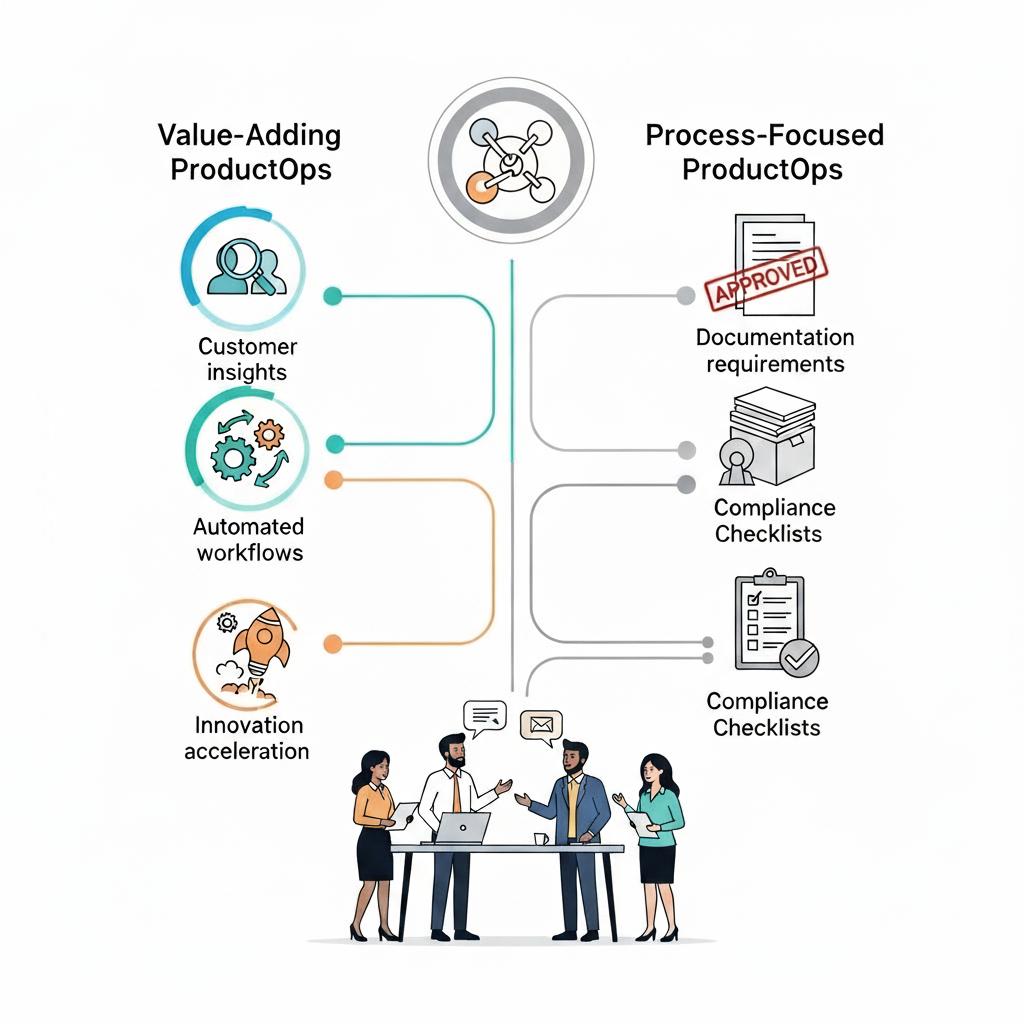
The emerging field of Product Operations aspires to make product teams more efficient and effective, but it can easily become another layer of bureaucracy that optimizes for internal metrics rather than customer value. According to ProductBoard's 2025 State of Product Ops report, 96% of product teams already implementing ProductOps functions. With this type of adoption, leaders need frameworks for distinguishing between value-adding operations and process overhead.
The critical insight: ProductOps succeeds when it removes friction from customer value creation. It fails when it becomes focused on process compliance and internal tooling adoption. This article explores the warning signs of ProductOps gone wrong, provides frameworks for implementing operations that actually accelerate teams, and shares real-world lessons from both successful and failed implementations.
You'll learn how to evaluate ProductOps initiatives through a customer value lens, build lightweight operational frameworks that enhance rather than constrain innovation, and navigate the cultural dynamics that determine whether operations becomes a competitive advantage or expensive overhead.
The Software That Nobody Wanted
Our VP of product was drowning. Managing multiple product teams while trying to maintain strategic direction, he thought bringing in new product management software would help organize our chaos. The platform promised better roadmap visibility, improved stakeholder communication, and data-driven decision making. On paper, it looked like exactly what we needed.
Unfortunately, nobody wanted to use it.
The software felt like we were filling a digital paperwork black hole. Checking boxes, tagging features with metadata, explaining the obvious, and updating status fields didn't make anyone better at understanding customers or building great products. The tool optimized for process compliance and making cool dashboards, rather than insight generation. So teams ignored it completely, continuing to use their familiar combination of spreadsheets, wiki pages, Slack conversations, and hallway discussions.
When the VP approached the product management software company for help with adoption, they had a ready solution: hire a ProductOps person to drive adoption and ensure compliance. This seemed logical. We needed someone to bridge the gap between our chaotic reality and the organized future the software promised.
What followed was a cautionary tale of good intentions creating organizational dysfunction. The ProductOps hire came from a large international operations company with impressive credentials in compliance and process enforcement. Unfortunately, this person had very little understanding of product management, customer development, or the creative problem-solving that drives innovation.
The culture clash was immediate and painful. Our teams valued speed, experimentation, and direct customer feedback. The new ProductOps person valued completeness, standardization, and process adherence. Every interaction became a negotiation between getting work done and following procedures. The VP ended up spending more time managing the ProductOps conflicts than he had spent on the original coordination problems.
Eventually, the ProductOps person quit in frustration, we stopped using the software, and we pretended the whole experiment never happened. But the experience taught me something crucial: ProductOps isn't inherently good or bad. It's effective when it amplifies customer value creation and destructive when it prioritizes internal process metrics over market impact.
When ProductOps Accelerates vs. When It Suffocates
The difference between value-adding ProductOps and process bureaucracy comes down to a simple test: Does this operation make teams better at creating customer value or better at following internal procedures?
This distinction matters because ProductOps can easily become an end in itself rather than a means to better customer outcomes. Teams can spend significant energy optimizing internal processes while losing sight of the market impact they're supposed to create.
Value-Adding ProductOps focuses on:
- Removing friction from customer feedback loops by automating data collection and analysis that helps teams understand user behavior faster
- Automating administrative tasks that consume creative energy, freeing product managers to focus on strategic thinking and customer research
- Providing data that improves product decisions rather than data that satisfies internal reporting requirements
- Enabling faster experimentation and learning cycles through better tooling and streamlined approval processes
- Connecting teams with customer insights and market intelligence that influences product direction
Process-Focused ProductOps emphasizes:
- Compliance with internal tools and procedures regardless of whether they improve decision-making quality
- Standardization for the sake of consistency rather than optimization for different team contexts and needs
- Metrics that measure process adherence rather than customer outcomes or business impact
- Documentation and approval workflows that slow decision-making without adding meaningful oversight
- Internal stakeholder satisfaction over customer value creation and market responsiveness
"ProductOps done right makes the entire product organization more effective. ProductOps done wrong makes everyone busy without creating any customer value." - Claire Vo from ChatPRD
The Three-Part ProductOps Evaluation Framework
Before implementing any ProductOps initiative, run it through this three-part evaluation:
Customer Impact Filter: Every ProductOps initiative should answer "How does this help teams better understand or serve customers?" If the answer isn't clear and compelling, the initiative likely focuses on internal optimization over market value. The best operations create shorter feedback loops between product decisions and customer outcomes.
Friction Analysis: ProductOps should reduce the time and energy required for high-value activities like customer research, experimentation, and strategic decision-making. Operations that add steps, approvals, or documentation requirements to these activities usually create more problems than they solve, regardless of their internal benefits.
Innovation Enablement: The best ProductOps creates space for creative thinking and strategic work by automating routine tasks and providing relevant insights. Operations that consume creative energy with administrative requirements typically reduce rather than enhance innovation capability, even when they improve internal coordination.
The Data Behind ProductOps Success and Failure
The research on ProductOps effectiveness reveals both significant opportunities and substantial risks. McKinsey research shows that improved organizational communication can raise productivity by up to 25%, but the quality and relevance of that communication matters more than the quantity or documentation completeness.
AirOps Product Operations Research indicates that 39% of product teams already have official ProductOps functions, with rapid growth continuing across the industry. However, the same research reveals a troubling insight: 43% of captured organizational data goes unused. This highlights the risk of operations focused on data collection and process compliance rather than insight generation and decision support.
The gap between data collection and data utilization suggests that many ProductOps initiatives optimize for internal metrics rather than customer value creation. Teams become busy gathering information and following procedures without translating that activity into better product decisions or customer outcomes.
"The best ProductOps people think like product managers about the internal product of how product teams work." - Denise Tilles from the ProductOps Community
When ProductOps professionals apply product management principles to internal operations, they focus on user experience (the product team's experience), customer outcomes (better product decisions), and iterative improvement based on feedback. This approach creates operations that serve teams rather than constraining them.
The Competitive Advantage Story: Technical Experiments at Scale
I experienced the power of well-designed ProductOps while working at a startup filled with former enterprise executives and engineers. These talented people wanted to build the biggest, most robust, most scalable solutions for our nascent customer base. Their instincts came from environments where over-engineering was safer than under-engineering.
As product managers, we struggled to control their insatiable craving to scale prematurely, over-architect solutions, and resist the incremental technical debt that enables rapid iteration. They viewed our push for minimum viable products as shortsighted and amateurish.
Rather than fighting their engineering culture, we introduced a process of technical experiments alongside our product experiments. These technical experiments had specific goals for efficiency, performance, and scalability that we validated with real system data. Engineers could propose infrastructure investments, but they had to justify them with measurable hypotheses and success criteria.
While engineers initially felt constrained by this approach, they quickly became skilled at justifying scale investments with concrete evidence rather than theoretical assumptions. The framework gave them a way to advocate for technical improvements while helping product managers understand the genuine benefits of infrastructure work.
Key Takeaway
The operation succeeded because it enhanced both engineering satisfaction and product decision-making. Engineers felt heard and respected while product managers gained visibility into technical trade-offs. The process served both constituencies while maintaining focus on customer value creation.
Building ProductOps That Actually Works
Based on experience with both successful and failed ProductOps implementations, here are practical guidelines for building operations that accelerate rather than constrain product teams:
Start With Customer Value, Not Internal Efficiency
Before implementing any ProductOps initiative, establish clear connections to customer outcomes. Ask "How will this help teams understand customers better or deliver value faster?" Operations disconnected from customer impact usually become bureaucratic overhead, regardless of their internal benefits.
The most successful ProductOps initiatives improve the speed or quality of customer feedback loops. They might automate user research synthesis, streamline experiment analysis, or provide better visibility into feature adoption patterns. The connection to customer value should be direct and measurable.
Implement Minimum Viable Operations
Apply product thinking to your operations initiatives. Start with the smallest possible intervention that addresses a real team pain point, then iterate based on results. Avoid comprehensive platforms or process overhauls that require significant behavior change from established teams.
Begin with operations that solve immediate problems experienced by your most effective product managers. If your best performers can't see the value in a ProductOps initiative, it probably focuses on internal optimization rather than market impact.
Focus on Friction Removal, Not Process Addition
Identify the administrative tasks and coordination overhead that prevent teams from doing strategic work. Build operations that eliminate these friction points rather than adding new approval or documentation requirements.
The best ProductOps initiatives make existing work easier rather than creating new categories of work. They might automate status reporting, streamline stakeholder communication, or provide self-service access to customer insights. The goal is amplifying existing capabilities rather than changing fundamental workflows.
Timeline expectations: Start with one high-impact, low-friction operation. Measure adoption and value creation for 30 days before expanding. Build credibility through small wins that demonstrate clear value rather than comprehensive transformation programs that require extensive change management.
Track metrics that connect operations to product outcomes, not just internal process compliance. Measure whether teams make better decisions faster, not whether they follow procedures completely.
The ProductOps Reality Check
ProductOps represents a critical evolution in how product organizations scale their capabilities, but success requires unwavering focus on customer value creation rather than internal process optimization. The teams that implement operations correctly create sustainable competitive advantages through better coordination, faster learning cycles, and reduced administrative overhead that frees creative energy for strategic work.
The teams that get ProductOps wrong create expensive bureaucracies that optimize for compliance over customer impact. They consume creative energy with process requirements, slow decision-making with approval workflows, and measure success through internal metrics that have no connection to market outcomes or customer satisfaction.
The difference isn't about the specific tools or processes you choose. It's about the mindset you bring to operations design. Do you think like a process enforcer trying to standardize team behavior, or do you think like a product manager trying to improve team effectiveness at creating customer value?
As organizations scale and face pressure for more formal operations, this distinction becomes increasingly important. The companies that master customer-focused ProductOps will adapt faster, innovate more consistently, and build deeper customer relationships than competitors trapped in process-focused bureaucracies.
At Collective Nexus, I help product organizations design operations that amplify rather than constrain their ability to create customer value. Whether you're evaluating ProductOps software, hiring operations talent, or optimizing existing processes, the frameworks I teach through strategic consulting provide systematic approaches for building operations that serve your teams and customers rather than internal stakeholders seeking process compliance.
Considering ProductOps for your organization? Let's discuss how to implement operations that accelerate customer value creation rather than optimize internal metrics. The choice you make will determine whether operations becomes your competitive advantage or your biggest overhead expense. The difference between these outcomes isn't about budget or technology. It's about approach, mindset, and relentless focus on what actually matters for your customers and your business.