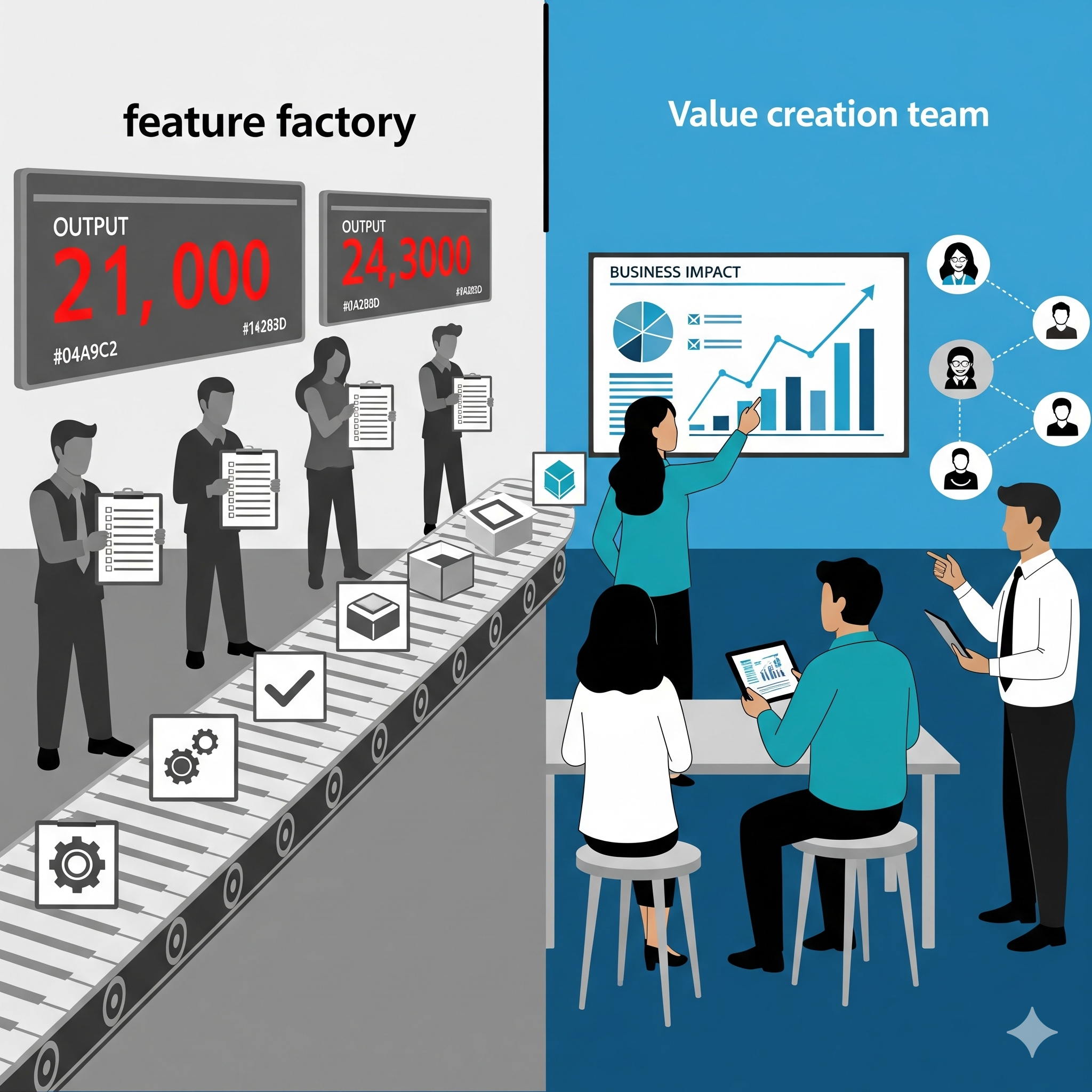
Most product teams are trapped in a feature factory cycle, measuring success by story points completed and features shipped rather than customer value created. This output-focused approach creates busy teams that deliver low-impact solutions while missing opportunities for breakthrough customer outcomes.
The transformation from feature teams to value creation teams isn't just organizational. It's philosophical. It requires fundamentally changing how teams think about their work, from order-takers executing requirements to entrepreneurs solving customer problems. This shift transforms team dynamics, measurement systems, and strategic thinking.
Based on experience leading this transformation across startups and Fortune 500 companies, this article provides a practical framework for restructuring teams around customer outcomes. You'll learn how to identify feature factory symptoms, implement value-focused measurement systems, and navigate the resistance that inevitably emerges when shifting from familiar output metrics to outcome-based success.
The companies that make this transition successfully don't just ship better products. They build organizations that can adapt faster, innovate more consistently, and create sustainable competitive advantages through deep customer value creation.
The Onboarding Optimization Breakthrough
I once worked with a team trapped in a classic feature factory battle. The business team wanted customers onboarded as fast as possible, measuring success by speed and conversion rates. Another team focused on data completeness, measured success by the percentage of complete customer profiles. Both teams were optimizing their metrics and shipping features regularly. Both teams were failing their customers.
The onboarding flow had become a tug-of-war between speed and completeness, with each team tweaking elements to optimize their respective metrics. Fast onboarding created incomplete profiles that required constant follow-up. Complete data collection created lengthy forms that scared away potential customers or led to people mindlessly clicking through pages while filling the system with unverified and potentially conflicting data. We were busy, we were shipping features, but we weren't solving the underlying problem.
Instead of continuing to optimize competing metrics, we created a new measure of customer readiness. This middle-ground approach focused on collecting the minimal data needed for customers to compete in the marketplace and gain initial traction. Once customers experienced value, convincing them to provide additional data became much easier.
This shift from feature optimization to outcome focus completely changed our product trajectory and taught me why the transformation from feature teams to value creation teams matters so much.
The Feature Factory vs Value Creation Model
Identifying Feature Factory Symptoms
Feature factories share common characteristics that make them easy to identify. Teams measure success through output metrics like story points completed, features shipped, and velocity trends. Planning focuses on capacity allocation and delivery timelines rather than customer impact. Discussions center around what to build next rather than whether current features create meaningful value.
Most telling, feature factory teams rarely have direct customer contact. They receive requirements through intermediaries and ship features based on internal requests rather than validated customer needs. The symptoms include:
- Sprint retrospectives focused on delivery velocity rather than customer outcomes
- Roadmaps organized by features rather than customer problems
- Success celebrations when features ship, regardless of customer adoption
- Planning meetings that start with resource allocation rather than customer needs
- Teams that can't explain how their work connects to business results
The Value Creation Team Model
Value creation teams organize around customer outcomes rather than feature delivery. They measure success through customer behavior changes, business impact metrics, and validated learning about customer needs. Planning focuses on identifying the highest-impact problems to solve and experimenting with different solution approaches.
"The shift from feature teams to outcome teams isn't just organizational, it's philosophical. It requires leaders who understand the difference between being busy and being effective." - Jeff Patton, User Story Mapping
Melissa Perri from the Product Institute adds crucial context: "When teams focus on customer outcomes instead of feature delivery, magic happens. They start thinking like entrepreneurs instead of order-takers."
The Three Pillars of Transformation
Customer Outcome Focus: Teams define success through measurable changes in customer behavior and satisfaction rather than feature completion rates. Instead of celebrating when a feature ships, teams celebrate when customer metrics improve.
Empowered Decision-Making: Teams have authority to change their approach based on customer feedback and experiment results rather than following predetermined feature requirements. This means teams can pivot their solution approach without requiring approval for every change.
Continuous Learning Integration: Teams systematically capture and apply insights from customer interactions, failed experiments, and successful outcomes to improve their problem-solving capabilities. Learning becomes as important as delivery.
This transformation requires changing measurement systems, decision-making authority, and team incentives to align with customer value creation rather than feature production.
The Engineering Spreadsheet Story
The research on product team effectiveness supports this transformation approach. According to Productside survey data, one in five products fail to meet customer needs, highlighting the importance of strong product management focused on outcomes rather than outputs. Additionally, 56% of respondents rate their product manager's skills as average or below average, often because PMs focus on feature coordination rather than value creation.
Perhaps most importantly, Harvard Business Review research shows that teams engaging in healthy task conflict produce 35% more innovative solutions than those that avoid disagreement. This matters because value creation requires challenging assumptions about what customers need and questioning whether proposed features actually solve real problems.
I experienced this dynamic while working with an Agile team that had become a well-oiled feature factory. The head of engineering had elaborate spreadsheets tracking every story point through planning, building, and delivery. He could predict delivery timelines with impressive accuracy and optimize resource allocation across multiple projects. The system was beautiful in its precision, but it was completely disconnected from customer value.
The reality was that we shipped features that made no difference to anyone. When I raised this concern, he said that value creation was my problem. His job was delivery, and I should request better features if I wanted better outcomes. This response perfectly captured the feature factory mindset: clear separation between "building" and "value creation" with no shared accountability for outcomes.
Rather than arguing about responsibilities, I started adding feature utilization data to his beloved spreadsheets. We began tracking the percentage of wasted story points on features that customers didn't use. This data got his attention immediately. Suddenly, his perfectly optimized delivery machine was producing measurable waste.
We started incorporating estimates of customer value as a key input to his planning spreadsheets. This helped us better prioritize development work and transformed our relationship from delivery handoffs to collaborative problem-solving. The engineering team became partners in value creation rather than just feature implementers.
The transformation wasn't just about metrics. It changed how we talked about work, how we made decisions, and how we celebrated success. Instead of celebrating when features shipped, we celebrated when customer behavior improved.
Navigating Resistance to Outcome-Focused Thinking
The biggest challenge in transforming feature teams isn't technical. It's cultural. Teams that have optimized for delivery velocity often resist outcome-focused measurement because it feels uncertain and harder to control.
Common resistance patterns include:
- "Customer outcomes take too long to measure"
- "We can't control what customers do with our features"
- "Output metrics are more predictable for planning"
- "Business stakeholders expect feature delivery commitments"
These concerns are valid but addressable. The key is implementing outcome measurement alongside output tracking, not replacing it immediately. Teams need to build confidence in new measurement approaches while maintaining the delivery capabilities that got them this far.
Start with leading indicators that connect feature delivery to customer behavior. For example, track feature adoption rates alongside completion rates. Measure customer satisfaction scores alongside velocity metrics. This parallel tracking helps teams see the connection between their work and customer outcomes without abandoning familiar measurement systems.
Building Bridges Between Output and Outcome
The most successful transformations don't eliminate output metrics. They contextualize them within outcome frameworks. Teams learn to ask "Why does this feature matter?" before asking "How long will it take to build?"
This requires changing planning rituals, measurement dashboards, and success celebrations. But the changes don't happen overnight. They evolve as teams build confidence in outcome-focused thinking and see the business results that follow.
Implementing Your Transformation Framework
Week 1-2: Implement Value-Based Measurement
Start tracking customer outcome metrics alongside traditional delivery metrics. Measure feature usage rates, customer behavior changes, and business impact rather than just completion rates. Create dashboards that make value metrics as visible as velocity metrics.
Begin with simple measurements like feature adoption percentages, customer satisfaction scores, and business impact indicators. The goal isn't perfect measurement immediately. It's building the habit of connecting delivery work to customer outcomes.
Set up measurement systems that capture both leading and lagging indicators. Leading indicators might include customer research insights and experiment results. Lagging indicators include revenue impact and customer retention changes.
Week 3-4: Establish Direct Customer Contact
Give your development teams direct access to customer feedback through research sessions, support ticket reviews, or usage analytics. Teams that understand customer context make better decisions about what to build and how to build it.
This doesn't mean every developer needs to conduct customer interviews. It means removing barriers between teams and customer insights. Share customer research results in team meetings. Include customer feedback in sprint reviews. Bring design and UX team members into your discussions often and early. Make customer success stories and failure stories equally visible to development teams.
Create regular touchpoints where teams can hear directly from customers about their experiences with features. This might be monthly research sessions, UX research reviews, quarterly customer advisory meetings, or ongoing access to support ticket trends.
Month 2: Create Outcome-Focused Planning Rituals
Restructure planning sessions to start with customer problems rather than feature requests. Ask "What customer outcome are we trying to achieve?" before discussing implementation approaches. This simple change transforms team conversations from order-taking to problem-solving.
Set team authority boundaries that allow autonomous decision-making about how to achieve outcomes while maintaining alignment on what outcomes to pursue. Empowered teams can adapt their approach based on customer feedback without requiring approval for every change.
Establish regular outcome review sessions where teams share what they've learned about customer behavior and how it's informing their approach. These sessions should feel like learning conversations rather than status reports.
The Long-Term Impact of Value Creation Teams
Organizations that successfully transition from feature factories to value creation teams develop capabilities that compound over time. They build deeper customer understanding, faster adaptation to market changes, and more innovative solution approaches.
Measuring Success in the New Model
Success measurement in value creation teams requires balancing short-term delivery needs with long-term customer impact goals. Teams need metrics that guide daily decisions while connecting to strategic business outcomes.
Effective measurement frameworks include:
- Customer behavior metrics that show how feature changes affect user actions
- Business impact indicators that connect customer behavior to revenue and growth
- Learning velocity measures that track how quickly teams incorporate new insights
- Team empowerment indicators that show increasing autonomous decision-making capability
The goal isn't eliminating delivery metrics. It's contextualizing them within customer value creation frameworks that guide strategic decision-making.
Building Your Value Creation Culture
The transformation from feature teams to value creation teams represents one of the most important organizational changes product leaders can drive. It's the difference between building what's asked for and building what actually matters to customers.
This transformation isn't just about changing metrics or reorganizing teams. It's about fundamentally shifting how your organization thinks about success, from delivery velocity to customer impact. Teams that make this shift successfully don't just ship better products. They build organizational capabilities that create sustainable competitive advantages through deep customer understanding and value creation.
The companies that master this transformation become harder to compete against because they adapt faster, innovate more consistently, and build deeper customer relationships. They turn customer feedback into competitive advantage rather than just feature requests.
Key Takeaway
The shift from feature factories to value creation teams isn't just about changing what you measure—it's about transforming how your entire organization thinks about success. Teams that focus on customer outcomes rather than output metrics create sustainable competitive advantages through deep customer understanding and adaptive innovation capabilities.
At Collective Nexus, I help organizations navigate this transformation through systematic frameworks that align teams around customer outcomes while maintaining delivery effectiveness. Whether you're leading a small product team or transforming a large enterprise, the principles remain the same: focus on outcomes, empower teams, and measure what matters.
The frameworks I teach through AdaptableProduct.com provide step-by-step guidance for implementing outcome-focused product management. For organizations ready for comprehensive transformation, Collective Nexus strategic consulting offers customized approaches that fit your culture and business context.
Ready to transform your feature factory into a value creation engine? Let's discuss designing outcome-focused frameworks that align your teams around customer success rather than feature delivery. The shift from busy work to meaningful impact starts with changing how you define and measure success.