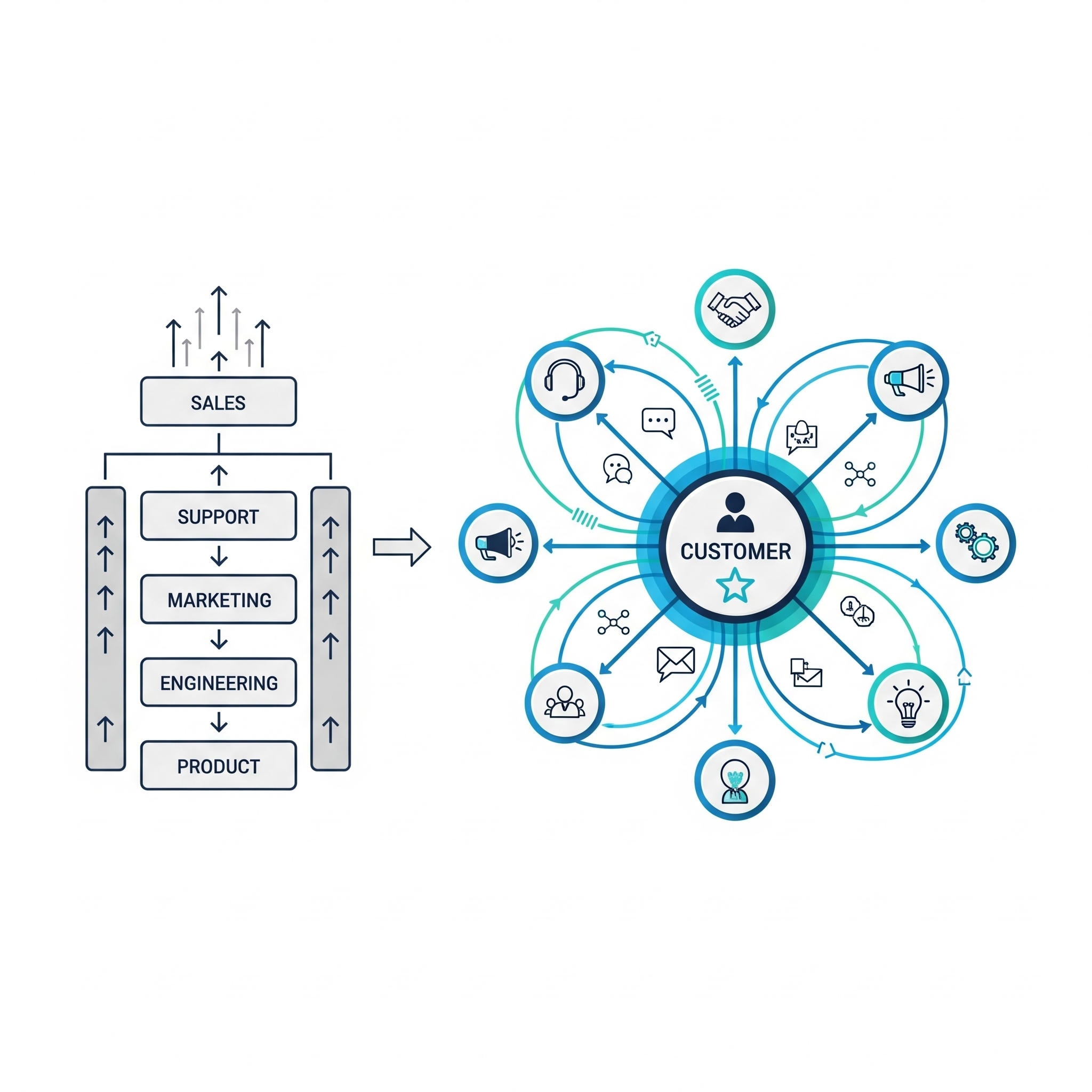
Most organizations trap product thinking within their product teams, missing massive opportunities to harness customer insights from sales, support, marketing, and other functions that interact with customers daily. This siloed approach limits innovation, wastes valuable intelligence, and creates misalignment around customer value creation.
The most successful companies expand product thinking beyond the product team to create organization-wide customer obsession. They turn every employee into a source of customer insight and product innovation.
A 2017 Cloverpop study found that diverse teams make better decisions 87% of the time, and Harvard Business Review reports that companies with inclusive cultures are 70% more likely to capture new markets. Yet, a survey cited by Alice Hewitt reported that 86% of workplace failures stem from poor collaboration and ineffective communication between departments. This disconnect reveals a massive opportunity for organizations willing to break down silos and expand product thinking across their entire workforce.
This article explores how experienced product managers build cross-functional communities that break down silos, amplify customer insights, and transform entire organizations into customer-focused innovation engines. You'll learn practical frameworks for engaging non-product stakeholders, building communities of practice, and creating systematic approaches to organization-wide product thinking that drive sustainable competitive advantage.
The Global Sales Intelligence Revolution
I worked at a global company with thousands of sales people and support staff spread across dozens of countries worldwide. As a product management team, we constantly struggled with adapting our consumer sites to local market needs and requirements. This is because, as a US-based company, it was always easiest to focus on the biggest markets like the United States and Western Europe to maximize short-term revenue.
Over time, this approach made us dangerously dependent on a few large markets while we fell behind competitors in emerging regions. We were losing ground in Asia, Latin America, and other growing markets where local competitors understood customer needs better than we did.
Having worked with so many of these global team members, we knew we had an incredible untapped resource sitting right in front of us: our international sales and support teams who understood local customer needs, competitive dynamics, and market opportunities better than anyone in our headquarters.
The problem was that we had no systematic way to capture and leverage their insights. Occasionally, regional sales managers would email us feature requests or complain about missing capabilities during quarterly business reviews. But these interactions were reactive, sporadic, and usually focused on specific tactical needs rather than strategic market understanding.
So my product team collaborated with our content teams to create communities of experts across regions and markets, involving them directly in our planning process rather than treating them as passive recipients of product decisions. We gave them formal seats on community councils where they represented their regional teams, provided structured feedback on what we could improve, and pitched new ideas with our help building compelling business cases.
Importantly, we helped them frame their pitches as problem-focused rather than solution-driven conversations. Instead of saying "We need a local payment method," they learned to say "Customers in this market abandon purchases because they don't trust international payment processors." This approach enabled us to find better solutions collaboratively while building regional expertise in product thinking.
Key Takeaway
The results exceeded our expectations. This systematic approach revealed patterns across markets that we never would have discovered from our US headquarters. We devised solutions that improved our competitive position globally while creating a powerful ongoing source of innovation and market intelligence.
Beyond the Product Team Silo
Traditional organizations create artificial barriers between customer-facing functions and product development, limiting product thinking to designated product teams. This siloed approach wastes valuable intelligence that exists throughout customer-facing organizations and creates dangerous misalignment around customer value creation.
The most successful companies recognize that customer insights flow through every department that touches customers. Sales teams understand market dynamics and competitive pressures. Support teams see recurring pain points and usability issues. Marketing teams know which messages resonate and which fall flat. Customer success teams understand onboarding challenges and expansion opportunities.
Yet most organizations treat these functions as downstream recipients of product decisions rather than upstream contributors to product strategy. This represents one of the biggest missed opportunities in modern business, especially as markets become more complex and customer expectations continue to evolve rapidly.
"The companies that win long-term are those where everyone, not just the product team, thinks like a product manager about customer value." - Jackie Bavaro from Asana
"Product thinking is a discipline, not a department. When your entire organization adopts customer-centric thinking, you become unstoppable." - Gibson Biddle, former Netflix VP Product
The Three Pillars of Product Community Building
Building a product community requires systematic implementation across three interconnected areas rather than hoping cross-functional collaboration emerges organically:
Cross-Functional Intelligence Networks: Create systematic channels for customer insights to flow from every department that touches customers directly or indirectly. Sales teams understand market dynamics and competitive positioning. Support teams see recurring pain points and feature gaps. Marketing teams know messaging effectiveness and customer acquisition challenges. Customer success teams understand onboarding friction and expansion barriers.
The key is building structured approaches to capture, categorize, and synthesize these insights rather than relying on informal hallway conversations or quarterly email updates. Organizations need regular forums, shared measurement systems, and clear processes for translating functional insights into product strategy inputs.
Problem-Focused Collaboration: Train non-product stakeholders to identify and articulate customer problems rather than jumping immediately to solution requests. This fundamental shift enables collaborative solution development that leverages diverse perspectives and expertise while maintaining strategic focus on customer value creation.
Instead of receiving feature requests like "Add a mobile app," product communities learn to surface underlying problems like "Customers can't complete transactions when they're away from their computers." This problem-focused approach opens up solution possibilities that individual functions might not consider while building shared understanding of customer needs across teams.
Shared Accountability for Customer Value: Establish metrics and incentives that align all departments around customer outcomes rather than internal process metrics or departmental goals. When sales teams care about customer satisfaction in addition to deal closure, when support teams focus on problem prevention in addition to ticket resolution, and when marketing teams measure customer lifetime value in addition to lead generation, product thinking spreads naturally throughout the organization.
The Data Behind Cross-Functional Success
The research on cross-functional collaboration reveals significant opportunities for organizations willing to break down traditional silos and embrace organization-wide product thinking. Harvard Business School research demonstrates that diverse teams make better decisions 87% of the time, highlighting the measurable value of incorporating perspectives from different functions and backgrounds into product decisions.
This finding becomes even more compelling when we consider that companies with inclusive cultures that actively welcome diverse input are 70% more likely to capture new markets, according to Deloitte research conducted through Harvard Business School. This statistic suggests that organizations limiting product decisions to product teams systematically miss critical market insights available from other functions throughout their organization.
Perhaps most revealing, Alice Hewitt reports that 86% of workplace failures are attributed to lack of collaboration or ineffective communication between departments. This research indicates that organizational silos aren't just missed opportunities for innovation and market insight. They're active barriers to business success that create costly failures across multiple business functions.
The Customer Service Intelligence Breakthrough
I experienced the transformative power of systematic cross-functional collaboration while working at a decades-old profitable company with well-established teams and deeply settled cultural patterns. Each team had developed their own metrics, processes, and communication styles over nearly two decades of operation, with minimal systematic communication between product and support functions.
The product teams focused exclusively on technology development and feature delivery while support teams concentrated on processing tickets and resolving customer issues as quickly as possible. Communication between these functions was limited to advance warnings about new feature releases and reactive reports when something broke after launch. This represented a massive missed opportunity for customer intelligence that was being generated daily but never systematically captured or analyzed.
Rather than accepting this status quo, I worked directly with customer service teams to transform their ticket data into a source of product intelligence. We started by cleaning up their existing ticket categorization system so we could identify overall cost areas and problem patterns across the entire customer base.
The challenge was that existing tickets weren't getting tagged accurately or consistently. Support agents were busy resolving issues and didn't have time for detailed categorization, so tags were often missing or incorrect. We improved their ticketing tool to automatically suggest relevant tags based on ticket content and customer context, making accurate categorization effortless rather than burdensome.
Additionally, we implemented simple sentiment analysis and machine learning categorization models to extract insights from ticket content automatically. This automation approach helped us understand not just what customers were reporting, but how they felt about their experiences and which issues created the most frustration or confusion.
The breakthrough came when we could create comprehensive reports showing how much time and effort every feature was actually costing the company through support requirements. This data revealed hidden problems and helped us prioritize fixes based on business impact rather than gut feelings or squeaky wheel dynamics.
We could identify where fixing specific features would provide the most value and track the support impact of new features after launch. Instead of waiting for people to escalate problems or report widespread issues, we could proactively identify and address emerging issues through ongoing data partnership with support teams.
This systematic approach revealed many hidden customer experience problems and significantly improved both customer satisfaction scores and overall ticket volumes. The transformation succeeded because we treated customer service as a valuable source of product intelligence rather than just an operational cost center that handled problems after they occurred.
Building Your Product Community
Creating an organization-wide product community requires systematic implementation across multiple areas rather than hoping collaboration emerges naturally. Here are practical frameworks for building cross-functional intelligence networks that actually influence product decisions:
Create Cross-Functional Advisory Councils
Establish regular, structured forums where representatives from sales, support, marketing, customer success, and other customer-facing functions can share insights and participate meaningfully in product planning processes. These councils work best when representatives have real authority to speak for their teams and genuine influence over product decisions rather than just advisory input that may or may not be considered.
Design these councils around specific customer challenges or market opportunities rather than general information sharing sessions. Focus each meeting on particular problems that require cross-functional perspective to solve effectively. Give council members preparation materials and clear frameworks for contributing insights relevant to the topic at hand.
Most importantly, demonstrate that council input influences actual product decisions by sharing how their insights shaped specific features, prioritization choices, or strategic direction changes. When non-product team members see their contributions making real impact, engagement and insight quality improve dramatically.
Implement Customer Intelligence Systems
Build systematic approaches to capture, categorize, and analyze customer feedback from all organizational touchpoints rather than relying on informal communication or sporadic reports. Use tools and processes that make it easy for non-product teams to contribute insights without adding administrative burden to their existing workflows.
Create shared dashboards that make customer insights visible across teams while protecting sensitive information appropriately. Sales teams should see support ticket trends relevant to their accounts. Support teams should understand upcoming product changes that might affect their workload. Marketing teams should access customer satisfaction data that informs messaging strategy.
The key is designing these systems to serve multiple constituencies rather than just feeding information to product teams. When customer intelligence systems help sales teams close deals, support teams prevent problems, and marketing teams improve campaigns, adoption and data quality improve naturally.
Train in Problem-Focused Thinking
Provide frameworks and training that help non-product stakeholders identify and articulate customer problems rather than jumping immediately to solution requests. This foundational skill enables collaborative solution development that leverages diverse expertise while maintaining strategic focus on customer value creation.
Start with simple templates that guide stakeholders through problem identification: What specific customer behavior or outcome are we trying to change? What evidence do we have that this problem affects multiple customers? What would success look like from the customer's perspective?
Help teams distinguish between problems and solutions by encouraging them to dig deeper into customer motivations and desired outcomes. Instead of requesting "better search functionality," train them to identify "customers can't find products they want to buy, leading to cart abandonment and lost revenue."
Align Incentives Around Customer Value
Establish metrics and rewards that encourage cross-functional collaboration on customer outcomes rather than optimizing individual departmental metrics in isolation. When all departments share accountability for customer satisfaction, product thinking becomes a natural part of everyone's role rather than an additional responsibility imposed from above.
This might mean adjusting sales compensation to include customer satisfaction scores, incorporating product quality metrics into support team evaluations, or tying marketing bonuses to customer lifetime value rather than just lead generation volume.
The goal isn't eliminating departmental metrics but contextualizing them within customer value frameworks that create shared accountability for overall customer success. When teams understand how their functional metrics connect to customer outcomes, cross-functional collaboration becomes strategically valuable rather than just politically correct.
Timeline expectations: Start with one pilot advisory council focused on your organization's biggest customer challenge or market opportunity. Run structured monthly sessions for 90 days, documenting insights and tracking their influence on product decisions. Expand to additional councils or different functional areas based on results and lessons learned from the initial pilot.
The Organization-Wide Product Transformation
Expanding product thinking beyond the product team represents more than improved collaboration or better communication between departments. It's about fundamentally transforming your entire organization into a customer-focused innovation engine that can adapt faster, innovate more consistently, and build deeper customer relationships than competitors trapped in traditional functional silos.
The companies that master this transformation create sustainable competitive advantages through systematic intelligence gathering that captures insights from every customer touchpoint, cross-functional problem-solving that leverages diverse expertise and perspectives, and shared accountability for customer value creation that aligns everyone around common goals.
These organizations turn every customer interaction into a source of product insight and every team member into a contributor to customer success. They build organizational capabilities that compound over time as teams get better at identifying problems, collaborating on solutions, and measuring customer impact across functional boundaries.
This transformation becomes especially valuable as markets become more complex, customer expectations continue rising, and competitive differentiation increasingly depends on customer experience rather than just product features. Organizations that can systematically harness customer intelligence from across their entire operation will consistently outperform competitors limited to insights from product teams alone.
The cultural change required for this transformation is significant but achievable with systematic implementation, clear frameworks, and leadership commitment to breaking down traditional silos. The organizations that invest in building product communities now will have substantial advantages as customer-centricity becomes an even more critical competitive differentiator.
At Collective Nexus, I help organizations build product communities that align entire companies around customer value creation rather than departmental optimization. Whether you're breaking down silos between existing teams, designing cross-functional collaboration from scratch, or transforming established cultures toward customer-centricity, the frameworks I teach through strategic consulting provide systematic approaches for expanding product thinking across your entire organization.
Ready to transform your company into a product community? Let's discuss how to build cross-functional collaboration that amplifies customer insights and accelerates innovation across your entire organization. The shift from departmental silos to organization-wide customer obsession starts with systematic frameworks that make product thinking accessible and valuable to every team member. The competitive advantages this creates compound over time as your entire organization becomes smarter about customer value creation.