Adaptable Product Leadership

Scaling Your PM Organization for Empowerment, Not Control

Move beyond command-and-control to build empowered product teams that make decisions close to customers. Learn frameworks that scale decision-making without creating bottlenecks.

8 min read Adaptable Product Leadership
Scaling PM Organization for Empowerment

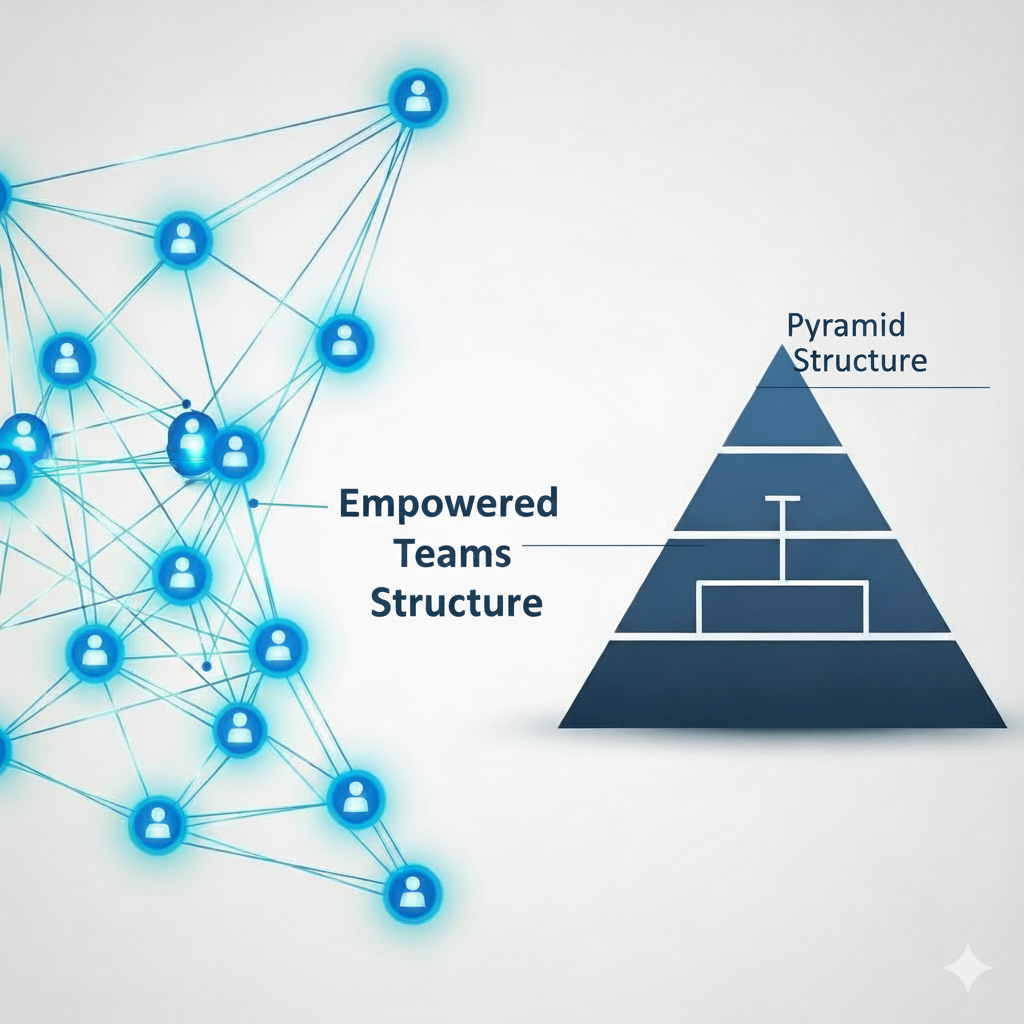
The fastest way to kill innovation in your product organization is requiring every decision to flow through a single point of control. Yet this is exactly what most companies do when they scale their product management frameworks. They create hierarchies, approval processes, and centralized planning that turn agile product teams into bureaucratic order-takers.

The companies that win at scale do something different. They build empowered product organizations where teams make decisions close to customers, where frameworks enable rather than constrain innovation, and where product managers focus on enabling great decisions rather than making all the decisions themselves.

This shift from control to empowerment isn't just philosophical. It's practical, measurable, and essential for organizations that want to move fast while growing large. Here's how experienced product leaders create frameworks that scale decision-making without creating bottlenecks.

The Planning Tax That Kills Innovation

I once worked at a global company in a department with 20 different teams. Leadership wanted to coordinate resourcing across all teams for every initiative. What they created was a planning nightmare that consumed our ability to actually build products.

The process worked like this: We spent an entire month each quarter planning for next quarter of work. But the planning wasn't straightforward resource allocation. It was a political battle to get your projects funded by ensuring they had the right executive support, cross-team alliances, and business pseudo-value attached to them. Then we spent most of the last month wrapping up initiatives for the review process and preparing for the next planning session.

The math was devastating. It was nearly a 50% planning tax on everything we did. While we were in meetings debating resource allocation, we weren't talking to customers, researching competitors, building prototypes, investigating new technologies, or collaborating on actual solutions. The planning process designed to make us more efficient was actually making us less effective.

This experience taught me that over-centralized product decisions don't just slow you down. They fundamentally change what your product teams spend their time doing. Instead of solving customer problems, they spend their energy navigating internal processes.

Why Empowerment Beats Control at Scale

The research on team empowerment tells a clear story that supports moving beyond command-and-control models. According to a study by McKinsey & Company, organizations that encourage team empowerment experience a 30% increase in overall team productivity. According to Gallup, companies with highly engaged teams achieve 23% more profitable. And a Harvard Business Review analysis found that companies with highly engaged employees outperform competitors by 147%. Yet despite 75% of employers rating teamwork and collaboration as "very important," 39% of employees say their organization doesn't collaborate enough.

This disconnect reveals the fundamental challenge of product organization scaling. Most leaders say they want empowered, collaborative teams, but their systems and processes create the opposite effect.

Teresa Torres from Product Talk explains the core insight that transforms how you think about product leadership: "The goal isn't to have product managers making all the decisions. It's to have product managers enabling great decisions to be made at every level." This shift in mindset changes everything about how you design your product organization.

Instead of creating systems that funnel decisions upward, you create systems that push decision-making down to where the customer context is richest and the feedback loops are fastest.

Empowerment Framework

The Framework That Scales Decision-Making

The key to empowering teams without losing strategic coherence is building product management frameworks that align decision-making rather than controlling it. As John Cutler from The Beautiful Mess puts it: "Scale comes from systems, not heroes. Build frameworks that make your team smarter, not more dependent on individual brilliance."

Here's the four-part framework I use to scale product organizations through empowerment:

1. Clear Vision and Strategy (The "Why" and "What")
Every team needs to understand the overall business strategy and how their work contributes to larger goals. But this doesn't mean micromanaging the "how." Give teams clear outcomes to achieve and trust them to figure out the best path forward.

2. Decision-Making Authority Boundaries
Define what decisions teams can make autonomously versus what requires consultation or approval. Most teams can handle feature prioritization, user experience improvements, and technical implementation choices. Fewer teams should make decisions about major platform changes or entering new markets.

3. Feedback and Learning Systems
Create mechanisms for teams to share learnings across the organization. When one team discovers something important about customer behavior or finds a new solution approach, that insight should flow to other teams quickly.

4. Support and Escalation Paths
Empowered doesn't mean abandoned. Teams need clear paths to get help when they're stuck and escalation procedures for decisions outside their authority. The goal is to minimize escalations while making them effective when needed.

When Empowerment Creates Breakthrough Results

One of my favorite examples of empowerment creating breakthrough results happened with a junior PM on my team. She had a data science background but wasn't working on any data science projects. Our official roadmap focused mostly on building platform capabilities, which didn't leverage her unique skills.

Instead of forcing her to work only on assigned projects, I encouraged her to spend extra time with the Customer Service team to understand their challenges and dig through their data. This autonomous exploration led to her identifying a new product opportunity that incorporated data science to solve real customer service problems.

She ended up pitching this idea to leadership and getting it funded as a new initiative. Not only did she get to use her data science skills, but she also had a great career story of building a zero-to-one project for an internal customer. The customer service team got a solution they didn't know they needed, and the company got a new product capability.

This breakthrough happened because we created space for autonomous exploration rather than controlling every aspect of her work. The framework enabled her to identify opportunities and take initiative without requiring approval for every step.

The Three Pillars of Empowered Product Organizations

Based on experience scaling product teams across startups and Fortune 500 companies, I've identified three pillars that support empowered product organizations:

Distributed Leadership

Empowered organizations don't just have product managers. They have product leaders at every level who can make decisions within their scope of authority. This means training team members to think strategically, giving them access to customer feedback and business context, and building decision-making skills at every level.

Distributed leadership requires intentional development. You can't just tell people to be more empowered. You need to give them the skills, information, and support they need to make good decisions independently.

Transparent Information Flow

Empowered teams need access to the same information that senior leaders use to make decisions. This includes sharing customer research, business metrics, competitive intelligence, and strategic context for better autonomous decisions. When teams understand the bigger picture, they make better decisions without constant supervision.

Many organizations hoard information at the top, then wonder why their teams make decisions that seem disconnected from business reality. Avoiding information hoarding that creates bad decisions is essential for team empowerment to work effectively.

Rapid Learning Cycles

Empowered organizations move fast because they learn fast. They create short feedback loops between decisions and outcomes, systematic learning capture and sharing, and safe spaces for experimentation and intelligent failure.

This requires building experimentation into your product development process, creating safe spaces for teams to try new approaches, and celebrating learning from failures as much as celebrating successes.

Building Your Empowerment Implementation Plan

Here's a practical roadmap for transitioning from control-based to empowerment-based product management frameworks:

Phase 1: Assessment and Foundation (Months 1-2)

Start by mapping your current decision-making bottlenecks and approval processes. Where do decisions get stuck? What approvals slow down your teams? Which processes add value versus which ones exist out of habit?

Survey teams about frustrations with current processes. Often, the barriers to empowerment are invisible to leadership but obvious to the people doing the work. Establish clear vision and strategy communication before you can empower teams to make decisions.

Phase 2: Framework Development (Months 3-4)

Create decision-making authority boundaries that define what each level of your organization can decide independently versus what requires consultation or approval. Start with broader authority boundaries and adjust based on results.

Develop information sharing systems and dashboards that give teams access to customer feedback, business metrics, and strategic context. Build feedback and learning capture mechanisms that create ways for teams to share discoveries, failed experiments, and successful approaches across the organization.

Phase 3: Pilot and Iterate (Months 5-8)

Start with pilot teams ready for increased autonomy. Give them clear success metrics and regular check-ins, but let them make decisions about how to achieve their goals.

Document what works and adjust frameworks based on results. Empowerment frameworks need modification based on real-world application. Gradually expand empowerment to other teams as you refine your approach and build organizational confidence.

The Long-Term Advantage of Empowered Organizations

Organizations that successfully scale through empowerment rather than control develop a sustainable competitive advantage. They can respond to market changes faster because decisions happen closer to customers. They retain top talent longer because people feel ownership over their work. They innovate more consistently because creativity isn't bottlenecked through a few senior decision-makers.

Most importantly, empowered product organizations build capabilities that compound over time. Every team member who learns to make strategic decisions makes the entire organization smarter and more capable.

At Collective Nexus, I work with organizations to design and implement empowerment frameworks that align with their culture and business goals. Whether you're scaling from 5 to 50 product team members or transforming decision-making across a large enterprise, the product management frameworks remain the same: push decisions down, push information out, and build systems that make your teams smarter rather than more dependent.

Ready to transform your product organization from command-and-control to empowered innovation? Let's discuss designing frameworks that scale your impact while maintaining strategic coherence. The shift to empowerment isn't just about changing processes. It's about building an organization that can adapt and thrive in an uncertain future.


About the Author: Nathan Rohm transforms decades of product management and leadership experience from startups and Fortune 500 companies into practical frameworks for building empowered product organizations. Through Collective Nexus strategic consulting and AdaptableProduct.com courses, Nathan helps leaders scale their impact through systematic empowerment rather than hierarchical control.

About Collective Nexus

We develop adaptive leaders and anti-fragile organizations through proven frameworks that combine strategic thinking with human connection. Ready to transform uncertainty into your competitive advantage?

Related Articles

Adaptable Product Leadership
Your First Product Manager Hire: The Make-or-Break Decision

Transform your organization from feature factory to strategic value creator with your first PM hire.

Product Community Building
Building a Company-Wide Product Community

Create a thriving product community that breaks down silos and amplifies learning across your organization.