Product Innovation

The Benefits of Healthy Conflict for Better Products: Fostering Good Fights That Drive Innovation

Transform destructive disagreements into generative product discussions that lead to better outcomes. Learn frameworks for fostering productive conflict that drives innovation without damaging relationships.

12 min read Product Innovation
The Benefits of Healthy Conflict for Better Products

Executive Summary

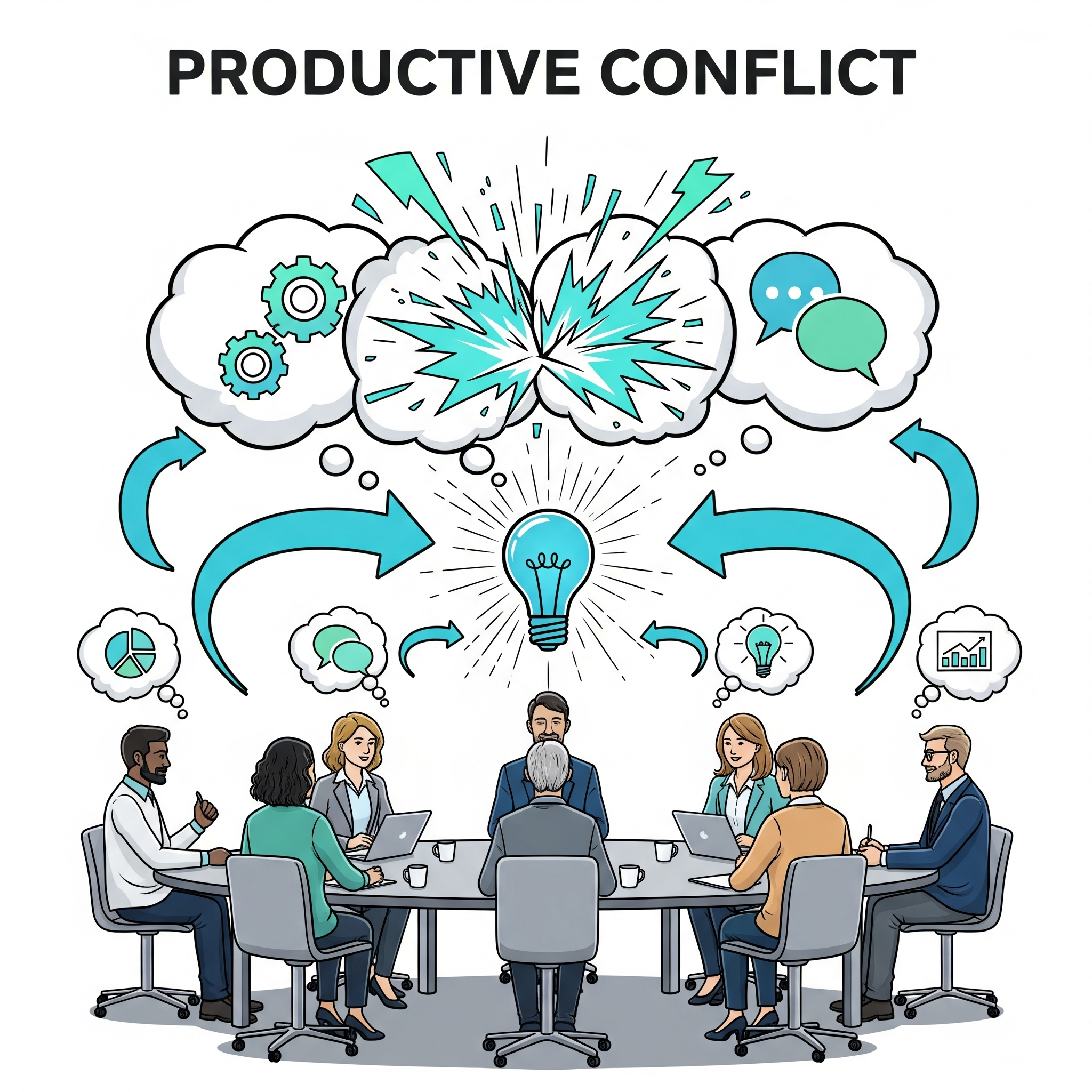
Here's a counterintuitive truth about high-performing product teams: they fight more, not less. While most organizations try to minimize conflict and chase consensus, the best product teams have learned to harness productive disagreement as their secret weapon for breakthrough innovation.

The data tells a compelling story. Product decisions that incorporate dissenting views consistently deliver significantly better long-term outcomes than consensus-driven decisions. Teams that engage in healthy task conflict produce more innovative solutions than those avoiding disagreement entirely. Yet many product organizations remain trapped in false harmony, mistaking agreement for alignment and silence for satisfaction.

The cost of conflict avoidance is higher than most leaders realize. Over 16% of product managers leave their roles due to poor team culture. We're not just losing talent. We're losing the diverse perspectives and challenging questions that drive better products. The frameworks and stories ahead will show you exactly how to transform destructive disagreements into generative discussions that lead to superior customer outcomes and stronger team relationships.

When Conflict Sparked Our Best Solution

Several years ago, I managed a product feature that consistently earned our lowest customer satisfaction scores: an image upload and categorization system. Users had to navigate countless dropdowns to categorize photos after uploading them, creating a frustrating experience that generated constant complaints and support tickets.

Our machine learning team had an automated image categorization model that achieved about 80% accuracy. The solution seemed obvious: integrate their model to eliminate the manual categorization burden. But there was a significant obstacle. Their system operated on a batch processing model that worked after images were uploaded, not during the upload process.

I asked the ML team to create an on-demand service that could work with our user interface in real-time. They refused, explaining that rebuilding their system for real-time processing would require a major engineering effort. We presented compelling evidence: customer satisfaction scores, user complaints, completion time data, and error rate statistics. The ML team remained unmoved. They weren't built for real-time image scoring and wouldn't invest in that capability.

The disagreement reached a standoff until one of our UI engineers discovered a client-side version of TensorFlow.js that could run on images as users uploaded them. Initially, this approach achieved only 65% accuracy, but it still represented dramatic time savings for users. When our ML team saw the working prototype, they offered to help improve the training model. Through collaboration, we eventually reached 80% accuracy without building a real-time service.

The result transformed our user experience. Customer satisfaction scores for photo management improved dramatically. But the bigger lesson was about the power of productive conflict. The initial disagreement forced our team to explore creative alternatives that satisfied everyone's constraints while solving the core user problem. The ML team understood the urgency and did want to help improve our customer experience. When the opportunity came to collaborate on a win-win solution, the ground was set, even if it had started with a conflict.

The Productive Conflict Framework

Destructive Conflict Characteristics: When Fighting Hurts

Most product teams have experienced destructive conflict that damages both relationships and outcomes:

Personal attacks and blame-focused discussions target individuals rather than exploring problems systematically. Positional arguments without exploring underlying needs create stubborn standoffs where people defend solutions without examining root causes. Win-lose mentality that damages relationships turns collaboration into competition, making future cooperation more difficult.

Perhaps most dangerously, avoidance of difficult conversations until problems explode allows small disagreements to fester into major crises that could have been prevented through early intervention.

Productive Conflict Framework

Productive Conflict Characteristics: When Fighting Helps

High-performing product teams channel disagreement differently:

Task-focused disagreements that challenge ideas, not people separate proposals from personal identity, making it safe to explore alternatives. Curiosity-driven exploration of different perspectives approaches disagreement as learning opportunities rather than battles to be won. Collaborative problem-solving that seeks better solutions treats conflict as a signal that current approaches may be insufficient.

Most importantly, these teams create regular, structured forums for voicing dissenting views so disagreement happens proactively rather than reactively.

Why Collision Beats Consensus in Product Development

Product development thrives on diverse perspectives because no single viewpoint can capture the full complexity of user needs, technical constraints, and market dynamics. When teams rush to consensus, they often overlook critical assumptions and miss superior alternatives.

Productive disagreement forces deeper problem exploration. It reveals blind spots that individual team members cannot see. It challenges conventional thinking that may have worked in the past but fails in current conditions. Most importantly, it creates the cognitive diversity necessary for breakthrough innovation.

Practical Application Steps

  1. Create safe spaces for disagreement in regular team processes and decision-making forums
  2. Establish ground rules that separate ideas from individual identity and focus on customer outcomes
  3. Build structured decision-making processes that actively invite dissenting views before finalizing choices
  4. Celebrate examples of productive conflict leading to better outcomes to reinforce cultural values

The Data Behind Conflict-Driven Innovation

Research Confirms the Disagreement Advantage

Multiple research studies demonstrate clear advantages for teams that embrace productive conflict. Harvard Business Review research shows that product decisions incorporating dissenting views have significantly better long-term outcomes than consensus-driven decisions. This advantage becomes even more pronounced in complex, rapidly changing environments where assumptions quickly become obsolete.

Studies on conflict and innovation reveal that teams engaging in healthy task conflict produce more innovative solutions than those avoiding disagreement. The key distinction is task conflict (disagreement about ideas and approaches) versus relationship conflict (personal animosity and interpersonal tension).

The Product Management Festival research highlighting that 16.4% of product managers leave their roles due to poor team culture underscores the importance of getting team dynamics right. Organizations that fail to foster healthy conflict often create cultures where either harmful conflict dominates or important disagreements get suppressed.

Expert Insights on Fighting Well

"The best product decisions come from the collision of different perspectives, not from consensus. Learn to fight well." - Kim Scott, author of Radical Candor
"Consensus is often the enemy of great products. You need a culture where the best idea wins, not the most popular one." - Ian McAllister, former Amazon Director of Product

These insights align with what I've observed across multiple organizations: the teams that produce the most innovative solutions are those that have learned to disagree productively while maintaining strong relationships.

Real-World Evidence: The Cost of Conflict Avoidance

The most expensive lesson I learned about conflict avoidance came when I joined a company and inherited a legacy user experience revamp already in progress. The head designer was leading an ambitious project to create three separate experiences: one for internal users, one for external customers, and one for auditing functions.

The approach felt overly complex and expensive from the beginning. My intuition suggested we were solving the wrong problem with an unnecessarily complicated solution. When my boss specifically asked whether I thought this was the best course of action, I had a perfect opportunity to voice my concerns and explore alternatives.

Instead, I avoided the difficult conversation. I was new to the organization and didn't want to challenge the head designer's expertise immediately. This conflict avoidance led to months of wasted effort on a project that was ultimately abandoned.

Things all fell apart after we discovered that the auditing function was being eliminated entirely. We also learned that internal teams would rather use the external interface most of the time because they had to see what users were experiencing. In the end, we could have built one interface with some advanced details available for internal users, achieving the same goals with dramatically less complexity and cost.

This experience taught me that avoiding difficult conversations early inevitably leads to much bigger problems later. The short-term discomfort of productive disagreement prevents the long-term pain of failed projects and wasted resources.

Three Systems for Building Productive Conflict Culture

1. Establish Conflict Protocols (Timeline: 2-4 weeks)

Start by creating explicit ground rules that separate ideas from individual identity. Develop structured formats for voicing disagreement safely, such as "I have a different perspective" or "What if we considered this alternative?" Train teams on productive conflict techniques, including active listening, assumption testing, and collaborative problem-solving.

The goal is making disagreement feel safe and constructive rather than threatening and personal. When people understand the rules of engagement, they can participate more confidently in challenging conversations.

2. Build Dissent into Decision Processes (Timeline: 1-3 months)

Strawman your own positions. Expect your PMs to systematically include opposing positions in major product decisions to ensure important alternatives get explored. Create regular forums where all of you regularly challenge your collective assumptions and explore different approaches before committing to specific directions. Even if nobody wants the alternatives, give them a chance to convince you. The sign of intelligence is the ability to hold two opposing viewpoints in your own heads. This is your team's chance to show off a bit!

On the other hand, watch out before things get out of hand. Establish clear escalation paths when disagreements need resolution, including criteria for when to involve senior leadership versus when teams should work through differences independently. The key is making dissent an expected and valued part of decision-making rather than an unwelcome disruption.

3. Celebrate Productive Conflict Outcomes (Timeline: 3-6 months)

Leadership modeling the desired behavior is also critical. Share stories of disagreements that led to better solutions, highlighting both the initial conflict and the superior results that emerged. Recognize team members who voice valuable dissenting views, even when their specific suggestions aren't adopted.

Build organizational memory around the benefits of healthy conflict through documentation, training, and cultural reinforcement. The goal is shifting from conflict avoidance to conflict competence across your entire product organization.

From Conflict Avoidance to Innovation Engine

The fundamental choice facing product leaders is between false harmony that produces mediocre results versus productive tension that drives breakthrough solutions. Consensus feels safer and more comfortable, but it often leads to lowest-common-denominator thinking that satisfies no one completely.

Productive conflict requires courage from both leaders and team members. Leaders must model productive disagreement and create psychological safety for challenging conversations. Team members must develop the skills and confidence to voice dissenting views constructively.

Throughout my career facilitating productive conflict across diverse product teams in startup and Fortune 500 environments, I've seen the transformative impact that healthy disagreement can have on both innovation outcomes and team satisfaction. The teams that learn to fight well don't just build better products. They build stronger relationships through shared problem-solving and mutual respect.

Ready to Transform Your Team's Approach?

Schedule a consultation through CollectiveNexus.com to assess your current conflict culture and develop strategies for fostering healthy disagreement. Explore systematic approaches to collaborative decision-making through the Adaptable Product Framework course, or connect with me on LinkedIn for ongoing discussions about building innovative team cultures.

The future belongs to organizations that can harness disagreement as a force for innovation. That future starts with learning to fight well.

About Collective Nexus

We develop adaptive leaders and anti-fragile organizations through proven frameworks that combine strategic thinking with human connection. Ready to transform uncertainty into your competitive advantage?

Related Articles

Product Leadership
Why Communities Beat Dictatorships: The Long-Term Product Leadership Strategy

Discover why collaborative product cultures outperform command-and-control environments.

Organizational Learning
Fostering Learning Across Your Product Organization

Transform individual product managers into a continuously evolving organization.