Organizational Learning

Fostering Learning Across Your Product Organization: From Individual Skills to Collective Intelligence

Transform individual product managers into a continuously evolving organization. Learn systematic approaches to building knowledge-sharing systems that compound team intelligence over time.

12 min read Organizational Learning
Fostering Learning Across Your Product Organization

Executive Summary

The most successful product organizations have cracked a code that eludes many at other companies: they've figured out how to transform individual expertise into collective intelligence that scales exponentially. While individual skills matter enormously, the organizations that consistently outperform their competitors are those that build systematic learning capabilities across their entire product teams.

The product management discipline evolves so rapidly that yesterday's best practices often become tomorrow's anti-patterns. As we'll cover in the following post, over 60% of product managers currently work in organizations with ad hoc or non-existent product management processes, leaving massive opportunities on the table. Research shows that product organizations with structured learning programs demonstrate significantly faster skill development across teams, while companies that systematically capture and share insights reduce repeated mistakes substantially.

This isn't just about training programs or individual development plans. It's about building learning systems that create compound advantages through shared intelligence, institutional memory, and continuous capability development. The frameworks and stories ahead will show you exactly how to transform your collection of smart individuals into a continuously learning community that gets stronger over time (and that will survive the coming and going of any smart individuals).

When Cross-Team Learning Solves the Unsolvable

Several years ago, I worked at a large global company obsessed with optimization. We had built our own sophisticated A/B testing platform that enabled us to run hundreds, sometimes thousands, of tests across different markets. We tested everything: content variations, feature implementations, user interactions, messaging approaches, and countless combinations of these elements.

To generate even more testing ideas, we had dedicated a team to tracking our competitors' tests. This benchmarking team would identify successful competitor experiments and adapt them for our own validation. It was a smart approach that had generated numerous wins, but they were struggling with one particular competitor whose tests consistently failed when we tried to replicate them.

Meanwhile, my team was conducting ongoing competitive analysis that included reviewing financial filings and investment information, looking for strategic signals and market changes we should monitor. During one quarterly report, I discovered an unusual note buried in a competitor's Management Discussion section. They disclosed that they had identified a significant bug in their own A/B testing platform that had been misreading results for potentially years, possibly impacting their reported returns during that period.

I immediately shared this insight across our organization. When our benchmarking team learned about the competitor's testing platform bug, the mystery of their failed replications suddenly made perfect sense. We had been trying to copy "successful" tests that were actually failures misreported by faulty analytics.

This cross-team knowledge sharing solved a puzzle that had consumed weeks of effort and prevented future wasted cycles. But another lesson was about the dangers of following competitors too closely without understanding the full context. Individual expertise from my financial analysis work became organizational intelligence that benefited multiple teams and shaped our strategic approach.

Individual vs Collective Intelligence Framework

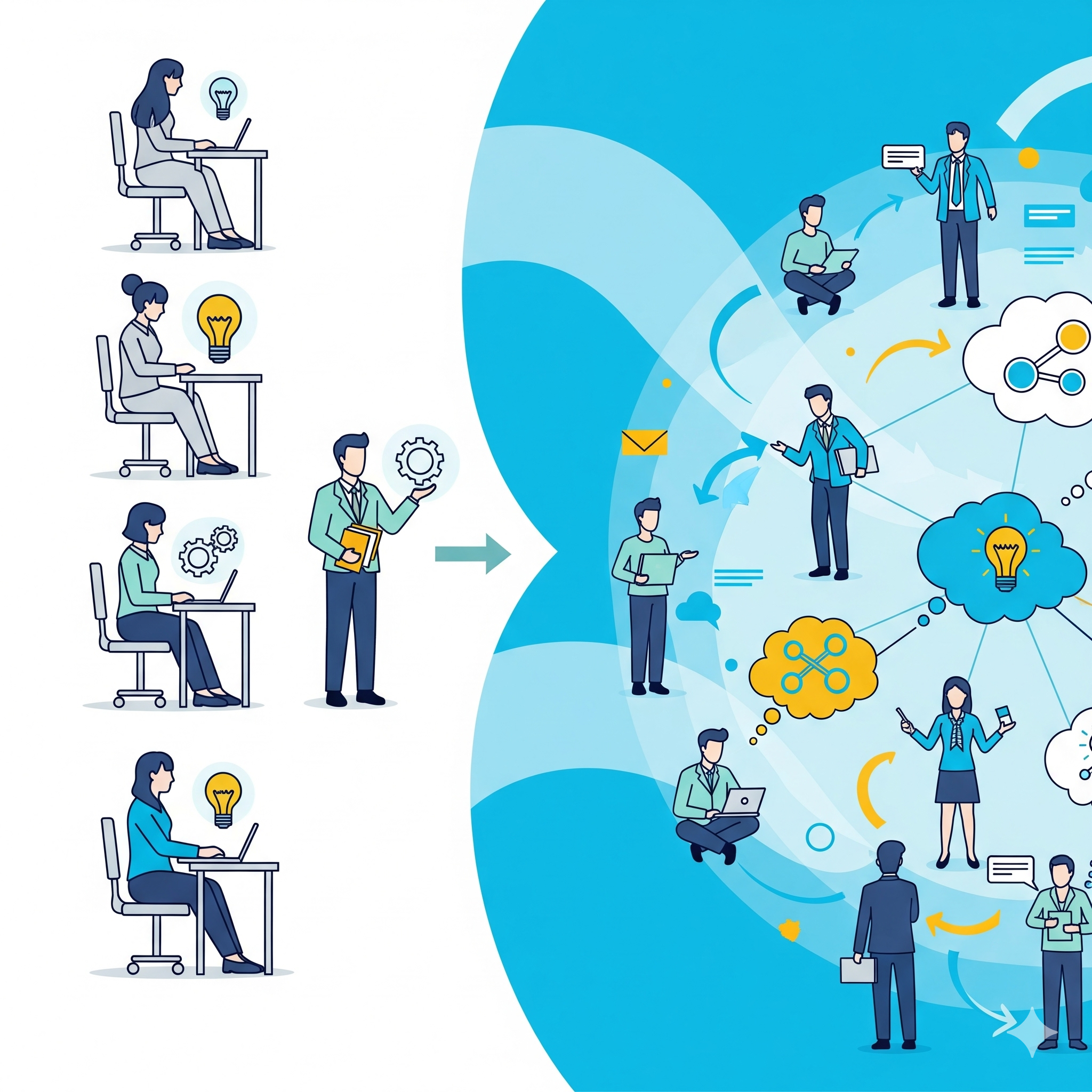
The Individual vs. Collective Intelligence Framework

Individual Learning Characteristics: The Limits of Solo Expertise

Most product organizations operate with individual learning models that seem efficient but create dangerous limitations:

Knowledge stays siloed within specific team members, creating single points of failure and missed opportunities for broader application. Insights depend on individual initiative and capacity, meaning organizational learning varies dramatically based on personal motivation and available time. Learning compounds slowly and inconsistently because knowledge doesn't flow efficiently between team members or across functions.

Most critically, organizations with individual-focused learning remain vulnerable to knowledge loss when people leave. Years of accumulated insights walk out the door with departing team members, leaving teams to rediscover lessons that were already learned.

Collective Intelligence Characteristics: The Power of Systematic Learning

Organizations that build collective intelligence operate on fundamentally different principles:

Knowledge flows systematically across teams and functions through established processes and shared repositories. Insights are captured, shared, and built upon by multiple perspectives, creating richer understanding than any individual could achieve alone. Learning compounds exponentially through network effects, where each new insight strengthens the entire system's capability.

Perhaps most importantly, these organizations build institutional memory and continuous capability that persists beyond individual tenure and creates sustainable competitive advantages.

Why Systematic Learning Beats Ad Hoc Approaches

The product management landscape changes so rapidly that systematic learning has become a competitive necessity rather than a nice-to-have. Market conditions shift monthly. Customer expectations evolve continuously. Technology capabilities expand at accelerating rates. Government regulations (or threats of tariffs) paralyze planning. Competitive threats emerge from unexpected directions.

In this environment, ad hoc learning approaches simply cannot keep pace. Individual team members may develop deep expertise in specific areas, but without systematic sharing mechanisms, that knowledge fails to benefit the broader organization. Collective intelligence creates compound advantages because learning builds upon itself, creating organizational capabilities that no individual could develop alone.

Practical Application Steps

  1. Audit current learning practices to identify gaps and inconsistencies across your organization
  2. Identify knowledge silos and information bottlenecks between teams and functions
  3. Create systematic knowledge-sharing processes that make learning visible and actionable
  4. Build learning accountability into performance management and team rituals

The Data Behind Learning-Driven Organizations

Research Confirms the Collective Advantage

Multiple research studies demonstrate clear advantages for organizations that invest in systematic learning capabilities. Product organizations with structured learning programs show significantly faster skill development across teams compared to those relying on individual initiative alone.

The Productside Report reveals that over 60% of product managers work in organizations with ad hoc or non-existent product management processes, representing enormous missed opportunities for systematic capability building. Companies that systematically capture and share product insights reduce repeated mistakes significantly, freeing teams to focus on innovation rather than rediscovering known solutions.

These findings align with what I've observed across multiple organizations: the structures that feel most efficient for individual productivity often become barriers to organizational learning and adaptation.

Expert Insights on Systematic Learning

"The product management discipline evolves so quickly that yesterday's best practices become tomorrow's anti-patterns. Learning has to be continuous and systematic." - Rich Mironov, Product Bytes
"Individual expertise matters, but collective intelligence scales. Build systems that make your whole team smarter." - Shreyas Doshi, former Stripe PM

These insights reflect a fundamental truth about modern product management: the half-life of specific knowledge continues shrinking, but the systems that enable continuous learning create lasting competitive advantages.

Real-World Evidence: The Power of Learning Accountability

The most transformative learning practice I've implemented came from a manager early in my career who taught me to develop learning plans alongside performance plans. This wasn't just about professional development. It was about recognizing that learning is fundamentally part of a product manager's job description.

Product managers serve as organizational learning scouts. We're the ones tracking market trends, competitive moves, technology evolution, and industry changes. We're in the crow's nest looking ahead for the entire ship, synthesizing information across multiple domains to help our teams navigate successfully.

The framework was elegantly simple: every PM developed specific learning objectives tied to organizational needs, established regular check-ins with managers for accountability and guidance, and tracked how new knowledge applied to team performance and strategic decisions.

The results were remarkable. PMs consistently appreciated these conversations because they enjoyed sharing discoveries and exploring possibilities. We developed rich discussions about market opportunities, competitive threats, and strategic options that emerged from systematic learning efforts. Most importantly, individual insights became team capabilities through regular sharing and application.

The accountability element proved crucial. Without manager support and regular check-ins, day-to-day operational demands inevitably consumed available time and energy. Knowing that managers would ask about learning progress made the difference between scheduling dedicated time for development versus hoping it would happen organically.

Three Systems for Building Collective Intelligence

1. Implement Learning Plans for Every PM (Timeline: 2-4 weeks)

Start by creating individual learning objectives directly tied to organizational needs and strategic priorities. These shouldn't be generic skill-building goals but specific knowledge areas that will enhance your team's competitive position and decision-making capability.

Establish regular check-ins with managers focused on learning progress and practical application. These conversations should explore how new insights might inform current projects, future opportunities, and strategic decisions. Track learning application and measure impact on team performance to demonstrate value and maintain momentum.

2. Build Cross-Team Knowledge Sharing Rituals (Timeline: 1-3 months)

Create regular forums for sharing insights across product teams, ensuring that individual learning becomes organizational intelligence. These might include monthly insight sessions, quarterly competitive briefings, or weekly market intelligence updates depending on your organization's pace and needs.

Establish post-mortem processes that capture and distribute learnings from both successes and failures. Build systems for tracking competitive intelligence, market trends, and customer insights that make collective knowledge easily accessible to all team members.

3. Create Institutional Learning Memory (Timeline: 3-6 months)

Build knowledge repositories that persist beyond individual tenure, ensuring that organizational intelligence survives team changes and continues growing over time. These systems should capture not just what was learned, but why it mattered and how it influenced decisions.

Establish mentoring programs that transfer tacit knowledge from experienced team members to newer ones. Develop frameworks for converting individual insights into team capabilities through documentation, training, and systematic knowledge transfer processes. Invite new members to take ownership over materials and rewrite them or rethink them.

Most of all, make sure people have an opportunity (and responsibility) to share, follow up, and pass on what they are learning. It needs to be modeled from the top and seen as a primary element of our roles as PMs, or it will fall away like any other non-urgent process that is not fighting fires every day.

From Learning Individuals to Learning Organizations

The fundamental choice facing product leaders is between building a collection of smart individuals versus building a continuously learning system that gets stronger over time. Individual expertise will always matter enormously, but collective intelligence scales in ways that individual capabilities simply cannot match.

The transition from individual-focused to system-focused learning requires intentional effort and sustained commitment. It means shifting from hoping that people will learn and share organically to building systematic processes that make learning visible, accountable, and actionable. It means treating learning not as individual development but as organizational capability building.

Throughout my career developing product managers across startup and Fortune 500 environments, I've seen the dramatic impact that systematic learning can have on both individual growth and organizational performance. The teams that make this transition don't just become smarter about current challenges. They develop the capability to learn and adapt faster than their markets change.

Ready to Transform Your Learning Capability?

Schedule a consultation through CollectiveNexus.com to assess your current learning systems and develop a strategic plan for building collective intelligence. Explore systematic approaches to team development through the Adaptable Product Framework course, or connect with me on LinkedIn for ongoing discussions about organizational learning and capability building.

The future belongs to organizations that can learn faster than change itself. That future starts with building systems that make your whole team smarter.

About Collective Nexus

We develop adaptive leaders and anti-fragile organizations through proven frameworks that combine strategic thinking with human connection. Ready to transform uncertainty into your competitive advantage?

Related Articles

Product Leadership
Why Communities Beat Dictatorships: The Long-Term Product Leadership Strategy

Discover why collaborative product cultures outperform command-and-control environments.

Product Community
The Three Pillars of a Thriving Product Community

Learn the foundational elements for building strong product communities within your organization.