Why Specialists Struggle When Markets Shift
Product managers spend 52% of their time on unplanned "fire-fighting" activities, according to the latest industry research. This statistic reveals a critical truth: the modern product landscape demands professionals who can think strategically across multiple domains while maintaining tactical excellence in execution.
The most effective product managers don't choose between growth optimization and platform development. They master both. These full-stack product professionals create sustainable competitive advantages by understanding how user acquisition strategies connect to platform capabilities, how conversion optimization depends on technical architecture, and how long-term growth requires strategic platform investments.
While many product managers specialize in either growth tactics or platform engineering, the leaders driving breakthrough results operate across the entire product spectrum. They bridge the gap between customer-facing optimization and infrastructure development, creating strategies that work today while building foundations for tomorrow's opportunities.
In this article, you'll discover why breadth of skills creates better strategic thinking, how to develop capabilities in both growth and platform domains, and why this combination drives more successful outcomes than narrow specialization. Most importantly, you'll learn practical steps for expanding your own full-stack product management capabilities.
From Simple Consumer Apps to Complex Platform Thinking
Early in my career, I focused entirely on building consumer web apps and content experiences. I loved the challenge of creating cohesive end-to-end user experiences where I could see the direct connection between product decisions and customer satisfaction. The feedback loops were immediate, the metrics were clear, and success felt tangible.
When I transitioned to a platform team supporting multiple internal and external customers, I discovered an entirely new level of complexity. Instead of optimizing for a single user journey, I now had to understand multiple use cases for our data and build systems and APIs that served existing needs while anticipating future requirements that customers didn't even know they had yet.
This is where my early experience building consumer experiences became invaluable. I could understand the strategies our platform customers were employing and start creating scenarios for where they might be heading. This helped me develop a roadmap that would empower them to do things they never knew they wanted, creating a flexible and adaptable platform that served their evolving needs for years to come.
The transition taught me that full-stack experience across different product types creates better strategic vision and anticipatory thinking. Understanding both customer-facing optimization and platform capabilities allows you to see connections that specialists miss, leading to more innovative solutions and sustainable competitive advantages.
The Full-Stack Product Manager Framework
The evolution from specialist to full-stack product manager requires understanding how different domains interconnect and influence each other. Let me break down the framework that separates strategic product leaders from tactical specialists.
Understanding the Product Spectrum
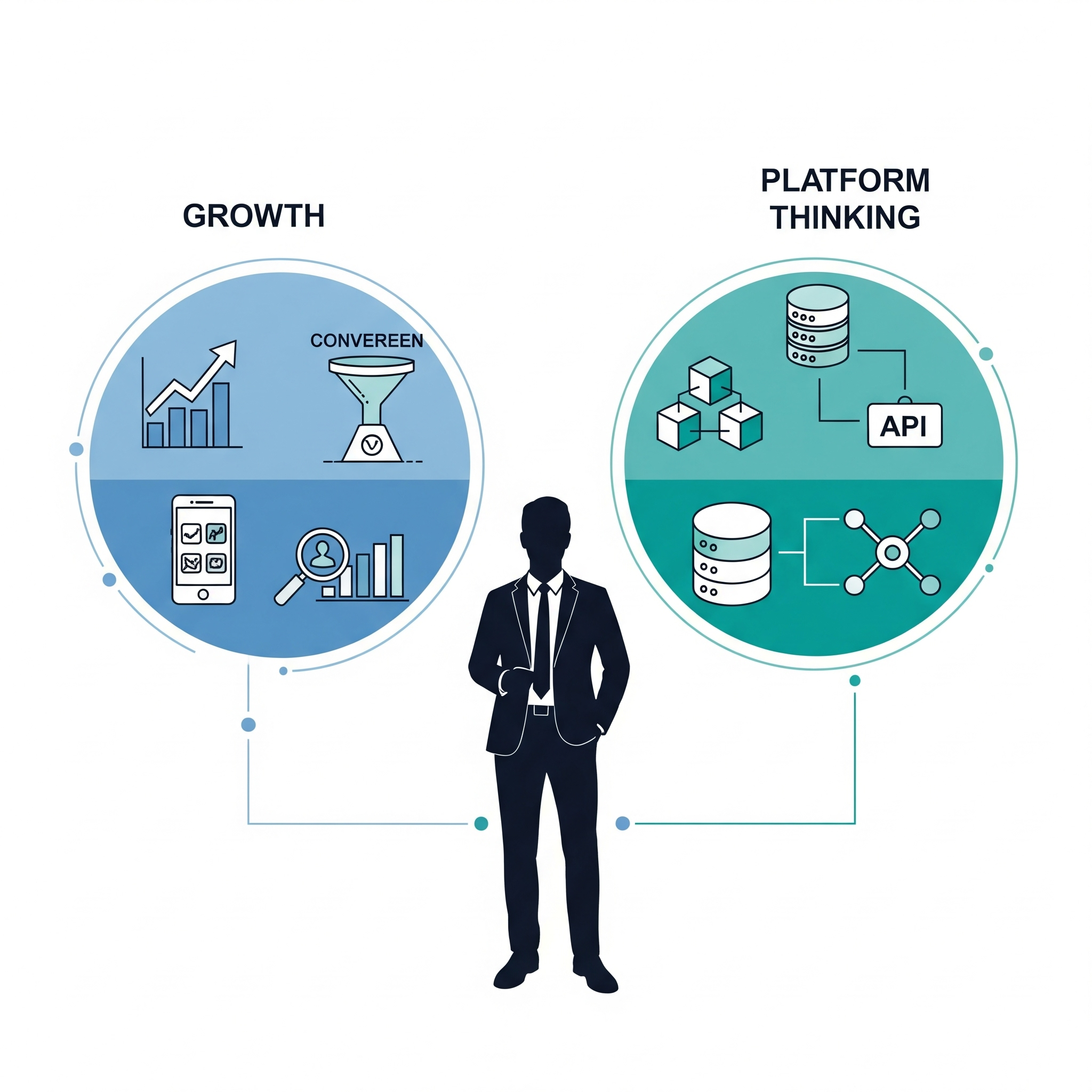
Growth-Focused Product Managers excel at user acquisition, conversion optimization, engagement metrics, and funnel analysis. They live in the world of A/B tests, cohort analysis, and customer journey optimization. Their success is measured in conversion rates, retention numbers, and revenue growth.
Platform-Focused Product Managers master APIs, infrastructure, technical debt management, scalability planning, and system architecture. They think in terms of developer experience, data integrity, integration capabilities, and long-term technical vision. Their success is measured in system reliability, developer adoption, and technical scalability.
Full-Stack Product Managers combine strategic thinking across both domains, understanding the interconnections and trade-offs between growth tactics and platform investments. They see how today's growth initiatives impact tomorrow's technical capabilities and how platform investments enable future growth opportunities.
The Three-Domain Mastery Model
The most effective full-stack product managers develop expertise across three interconnected domains:
User-Facing Growth Domain
This domain encompasses customer acquisition and retention strategies, conversion funnel optimization and A/B testing capabilities, user engagement and behavioral analytics, and go-to-market execution including pricing decisions. This domain focuses on driving immediate business results through customer-centric optimization.
Platform Infrastructure Domain
This includes API design and developer experience optimization, system scalability and technical architecture planning, data integrity and validation systems, and integration capabilities with extensibility for future needs. This domain builds the foundation for sustainable long-term growth.
Strategic Integration Domain
This represents the highest level of full-stack thinking: understanding how platform investments enable growth opportunities, balancing technical debt with feature velocity, maintaining long-term vision that connects infrastructure to customer value, and making resource allocation decisions across growth and platform initiatives.
Core Capabilities Required
Success as a full-stack product manager requires four essential capabilities:
Technical Fluency means understanding APIs, databases, and system design principles without needing to be an engineer. You should be able to participate meaningfully in architecture discussions and understand the implications of technical decisions on business outcomes.
Analytics Proficiency enables you to dive into metrics and draw insights without constantly relying on data analysts. This includes understanding statistical significance, cohort analysis, and the ability to design experiments that produce actionable results.
Systems Thinking allows you to see connections between growth tactics and platform capabilities. You understand how optimization efforts impact technical requirements and how platform limitations constrain growth opportunities.
Strategic Planning involves balancing short-term optimization with long-term platform investments. You can make resource allocation decisions that optimize for both immediate results and future capabilities.
The Research Behind Full-Stack Product Management
Industry data strongly supports the value of full-stack product management capabilities. McKinsey & Company research shows that 80% of product managers are involved in design activities and go-to-market decisions, with half also participating in pricing decisions. This breadth of involvement requires understanding how different product domains interact and influence each other.
The same research reveals that 60% of product managers have basic analytics skills that enable them to dive into metrics and draw insights without relying on analysts. This self-sufficiency becomes critical when you're operating across multiple domains and need to understand how growth metrics connect to platform performance indicators.
The challenge facing modern product managers is evident in recent statistics showing they spend 52% of their time on unplanned "fire-fighting" activities. This reactive mode often results from narrow specialization that creates blind spots. Full-stack capabilities help product managers anticipate problems across domains and build more resilient strategies.
"The best product managers think in systems, whether they're optimizing conversion funnels or designing platform APIs." - John Cutler, The Beautiful Mess
Casey Winters, former partner at Greylock Partners, reinforces this perspective: "Growth and platform aren't different disciplines, they're different lenses for creating sustainable customer value." The most successful product managers learn to apply both lenses simultaneously.
Platform Investments Driving Growth Outcomes
The value of full-stack thinking becomes clear when you see how platform investments directly enable growth outcomes. I experienced this firsthand while working on a platform that served over 20 different brands in 30 countries, along with an API community of hundreds of customers.
When we started, our platform served content data that was relatively flat, meaning there was potential for conflicts and duplications. From a platform perspective, the data was easy to manage, translate, and serve. But for our clients, it was a mess. Our API clients were working around these deficiencies by writing rules to avoid showing duplicate or conflicting data. Each brand had to implement these workarounds independently, creating inefficiency and inconsistent user experiences.
When we had the opportunity to rebuild our database for the next generation of AI and data-heavy tooling, we knew we had to do better for our clients so they could truly innovate their customer-facing experiences while trusting in the data. As someone who had run those endless A/B tests looking for a few points of improvement here and there, I knew how painful it was to have to add in layers of validation into my launch process when the data was potentially corrupted. So we also built in a robust validation layer. This platform investment helped us clean up millions of errors in our data and ensure no new problems would arise.
The growth impact was immediate and multiplicative. Our clients were able to greatly simplify their code and freely innovate on their user experiences while saving hours of testing This platform improvement enabled better growth outcomes for all our customers while reducing their development overhead.
This experience demonstrated how platform investments that solve systemic problems create multiplicative value for all customers. Full-stack product managers understand these connections and will go the extra mile to make strategic investments in order to drive both technical excellence and business growth.
Three Steps to Develop Full-Stack Product Management Skills
Transforming from a specialist to a full-stack product manager requires deliberate skill development across multiple domains. Here's a practical roadmap for building these capabilities systematically.
Step 1: Build Your Technical Foundation (Month 1-2)
Start by developing basic fluency in technical concepts without trying to become an engineer. Learn fundamental API concepts and understand how different systems communicate with each other. Study database fundamentals so you can understand data architecture discussions and their implications for product decisions.
Practice reading and interpreting technical documentation from popular platforms and APIs. This skill will help you understand what's possible with different technologies and how technical constraints impact product possibilities.
Shadow engineering teams during architecture discussions to understand how technical decisions get made and what factors influence system design. Pay attention to how trade-offs between performance, scalability, and maintainability affect product capabilities.
Step 2: Develop Cross-Domain Project Experience (Month 3-6)
Actively volunteer for projects that span both growth and platform work. Look for opportunities where you can see how technical decisions impact user experience and business metrics. These projects provide practical experience in balancing different types of requirements.
Analyze how platform limitations currently impact growth metrics in your organization. Create detailed maps showing where technical debt or system constraints prevent optimization efforts from reaching their potential. This analysis will help you understand the connections between technical and business performance.
Map customer journey pain points to underlying technical debt. Understanding which user experience problems stem from technical limitations helps you prioritize platform investments that will drive the biggest growth impact.
Create proposals that connect infrastructure investments to specific business outcomes. Practice building business cases that show how technical improvements will enable better customer experiences and stronger growth metrics.
Step 3: Master Strategic Integration Thinking (Ongoing)
Develop skills in explaining technical concepts to business stakeholders and business requirements to technical teams. This translation capability is essential for full-stack product managers who need to bridge different domains.
Build frameworks for prioritizing platform versus growth investments based on strategic value and resource constraints. Learn to evaluate opportunities across different time horizons and understand when immediate optimization should take priority over long-term platform development.
Develop expertise in resource allocation across different types of work. Understand how to balance team capacity between feature development, technical debt reduction, growth optimization, and platform enhancement.
Create documentation that connects platform capabilities to customer value. This practice helps you think systematically about how technical decisions impact user experiences and business outcomes.
Key Takeaway
Full-stack product managers create sustainable competitive advantages by understanding how growth and platforms work together rather than treating them as separate disciplines. This integrated thinking enables strategic decisions that optimize for both immediate results and long-term capabilities.
Building Sustainable Competitive Advantages
The breadth of full-stack capabilities separates strategic product leaders from tactical specialists who can only optimize within their narrow domain. While specialists become increasingly valuable within their expertise area, full-stack product managers can adapt to changing market conditions and identify opportunities that others miss.
This versatility becomes especially important as technology evolution accelerates and customer expectations continue rising. The product managers who thrive will be those who can think strategically across multiple domains while maintaining tactical excellence in execution.
The investment in developing full-stack capabilities pays dividends throughout your career. Whether you're working at a startup where everyone wears multiple hats or at a large organization where you need to coordinate across specialized teams, understanding both growth and platform thinking makes you more effective at driving results.
Transform Your Product Management Approach Today
Ready to evolve from specialist thinking to full-stack product leadership? The frameworks and development path outlined in this article can transform how you approach product strategy, but building these capabilities effectively requires ongoing support and practical application.
Learn systematic approaches to full-stack product thinking through courses at AdaptableProduct.com, where you'll discover the proven Adaptable Product Framework for building products that scale across both growth and platform dimensions.
Get personalized guidance on developing cross-domain skills through Collective Nexus consulting. Work with experienced product leaders who can help you identify the most valuable capabilities to develop based on your current role and career goals.
Build comprehensive career development plans with AI-powered planning at Subrize.com, where you can create detailed roadmaps for acquiring the full-stack capabilities that will drive your product management career forward.